
 Castellano
Carlos Alcaraz Returns in New York: The Champion Faces the Most Uncertain Challenge of His Career
Carlos Alcaraz returns to the US Open after four months out to defend his title and face the biggest physical and mental challenge of his career.
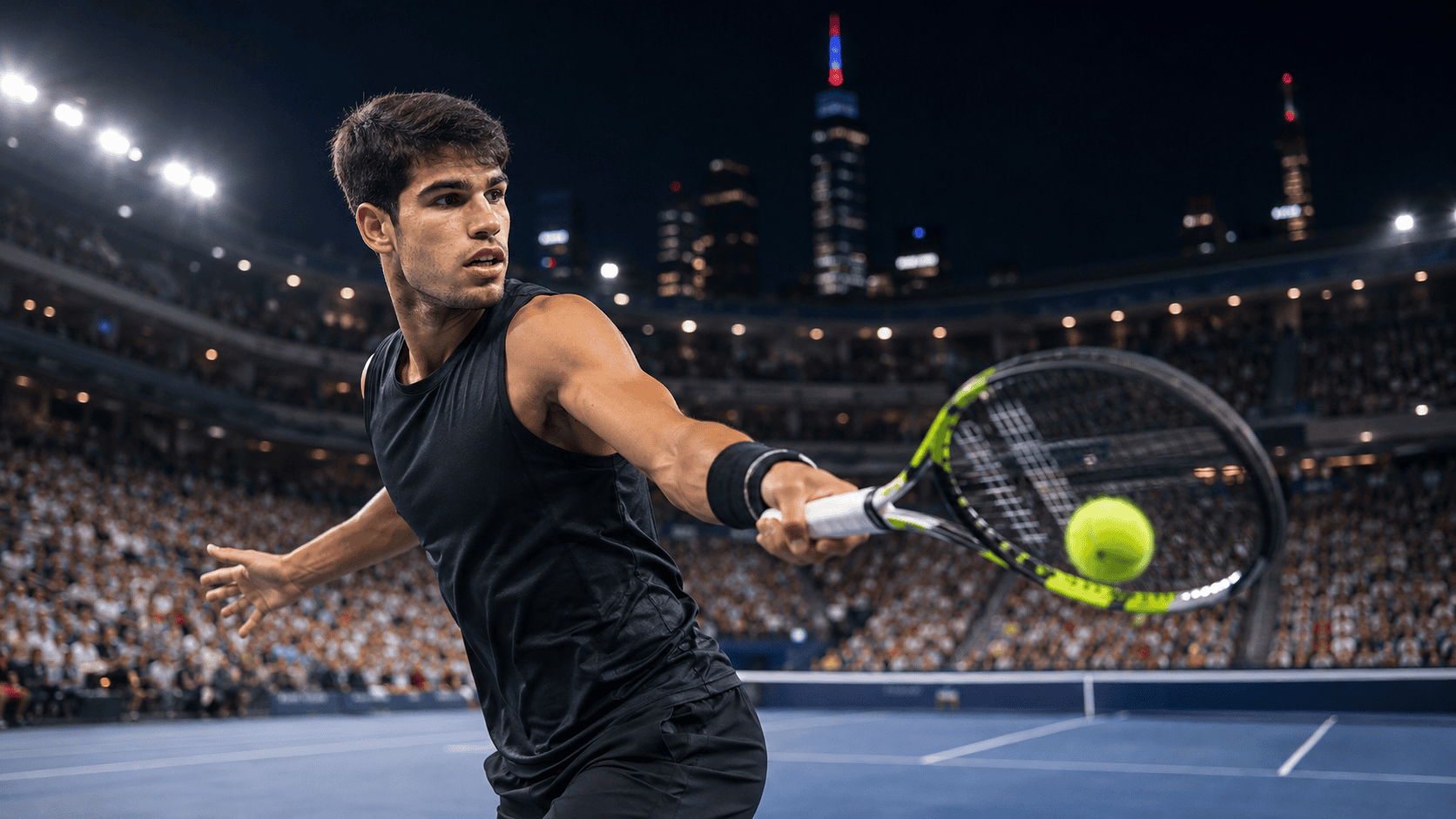
Four months after his last official match, Carlos Alcaraz returns to competition at the very tournament where he first reached the top of world tennis.
The Murcia native will make his comeback at the US Open after recovering from the right wrist injury he suffered in mid-April. The physical setback forced him to miss four Masters 1000 events—Madrid, Rome, Canada and Cincinnati—as well as two Grand Slams: Roland-Garros and Wimbledon.
There will be nothing gradual about his return. Alcaraz will go straight from a lengthy recovery period into the defence of a Grand Slam title—and his 2,000 ATP Ranking points—with best-of-five-set matches and the enormous pressure that comes with being the reigning champion.
New York is ready to welcome back one of its biggest stars, but this time his arrival is surrounded by uncertainty. His talent remains intact; the big question is whether his body, confidence and tennis will be ready to withstand two weeks of maximum intensity.
The Challenge of Playing Best-of-Five Matches After Four Months Out
The first major question concerns his physical response. Training at high intensity is one thing; competing in a Grand Slam is something entirely different. Matches can last more than four hours, while recovery between rounds becomes a decisive factor.
After four months without an official match, Alcaraz will arrive without the competitive rhythm provided by warm-up tournaments. He will not have had the chance to test how his wrist responds in genuine match situations: under pressure, with fatigue building and against opponents capable of forcing him to play one extra ball in every rally.
The US Open rarely offers much breathing room. The heat, humidity, night sessions and unforgiving hard courts can turn every round into a test of endurance. Even a seemingly favourable opening match could become complicated if the Spaniard needs several sets to rediscover his rhythm.
Managing the opening rounds will be crucial. If he can come through his first matches with authority and limit his time on court, he will be able to build momentum without placing excessive strain on his body. On the other hand, a series of long matches from the outset could seriously compromise his chances in the second week.
There is also a mental challenge. After suffering an injury to such an important joint, a player must regain the confidence to strike the ball without holding back. Subconscious doubts may appear at certain moments, particularly when making explosive movements or trying to accelerate the ball from uncomfortable positions.
Alcaraz will not only need to confirm that his wrist has healed. He must once again feel that he can push it to the limit without fear.
Protecting His Wrist Without Losing His Identity
The second challenge will be tactical. Alcaraz’s tennis is built around aggression, explosive shot-making and an extraordinary ability to change the rhythm of a point. Asking him to play too cautiously would take him away from the qualities that make him such a unique player.
However, his return will probably require a slightly more controlled version of his game.
The Spaniard will need to choose his moments to go for winners more carefully and avoid turning every rally into a display of raw power. His priority should be to construct points intelligently, dictate play from a balanced position and reduce forced shots that could place unnecessary strain on his right wrist.
His serve will be particularly important. A strong first-serve performance would allow him to play more short points, seize the initiative quickly and avoid lengthy baseline exchanges.
His ability to use the following tactical resources will also be crucial:
- Moving forward to the net and finishing points
- Using the backhand slice
- Turning to the drop shot to disrupt his opponents’ rhythm
- Varying height, spin and direction
- Avoiding forced shots from uncomfortable positions
Variety could become his most effective form of protection.
Instead of constantly chasing maximum speed, Alcaraz can rely on his extensive repertoire to move his opponent, create space and finish points with less physical strain. His ability to alternate rhythms gives him options that very few players possess.
Managing his aggression does not mean playing defensively. It means using that aggression with greater precision.
A Comeback That Transforms the US Open
Alcaraz’s presence completely changes the complexion of the tournament. Even without any competitive preparation, no seeded player will want to face him. His ability to raise his level on the biggest stages and turn seemingly lost matches around makes him an extremely difficult threat to assess.
For the leading contenders, his return introduces another layer of uncertainty. Nobody knows exactly which version of the Spaniard will appear in New York. He could be a player who is still short of match rhythm—or a rested, hungry champion determined to reclaim his place among the dominant forces on Tour immediately.
The draw and the outcome of the opening rounds will be hugely significant. A manageable early path could allow him to rediscover his tennis gradually. Facing aggressive opponents, big servers or players capable of extending matches early in the tournament would represent a far more dangerous test.
His comeback is also generating enormous international anticipation. Tennis has missed his energy, creativity and ability to produce shots that seem to defy logic during his four-month absence.
Alcaraz does not simply compete to win: he is one of those players who changes the atmosphere of a tournament every time he steps onto the court.
New York knows that feeling well. His connection with the crowd, electric style and competitive character are perfectly suited to the personality of the US Open.
New York Will Measure More Than His Title Chances
Considering Carlos Alcaraz one of the contenders would be perfectly logical given his talent and status as the defending champion. Expecting him to return after four months and immediately dominate a Grand Slam would be far less reasonable.
His performance in New York will primarily depend on three factors:
- How his right wrist responds
- His ability to regain match rhythm during the opening rounds
- How much energy he can preserve for the second week
Alcaraz does not need to produce his best tennis from day one. He needs to advance, compete without pain and gradually rebuild his confidence. If he can overcome that initial phase and reach the decisive rounds with his body responding well, his title challenge will become extremely serious.
The US Open will be a title defence, but also a test of maturity. For the first time, the Spaniard must prove that he knows how to return, adapt and compete without relying exclusively on his explosiveness.
New York awaits its champion. The question is not whether he still possesses the talent to win, but how long it will take him to feel completely free on a tennis court again.
Create Your Own Tennis Rankings
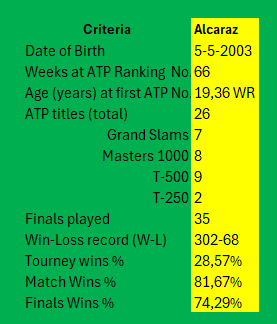
Want to analyse Carlos Alcaraz’s career and compare it with those of the greatest champions in tennis history? Use the Tennis Race for History filters to explore rankings by age, tournament, surface, country, era and many other criteria.
Discover More Historical Rankings
Explore tennis history using our filters. Compare players by tournament, surface, country, era, age and more to create your own rankings.
Explore the Rankings