
 Castellano
The Six Players Who Have Led the TRH All-Time Ranking - From Laver to Djokovic
Only six players have led the TRH All-Time Ranking since 1968. Discover its evolution from Rod Laver to Novak Djokovic.

Blog Article · TRH All-Time Ranking
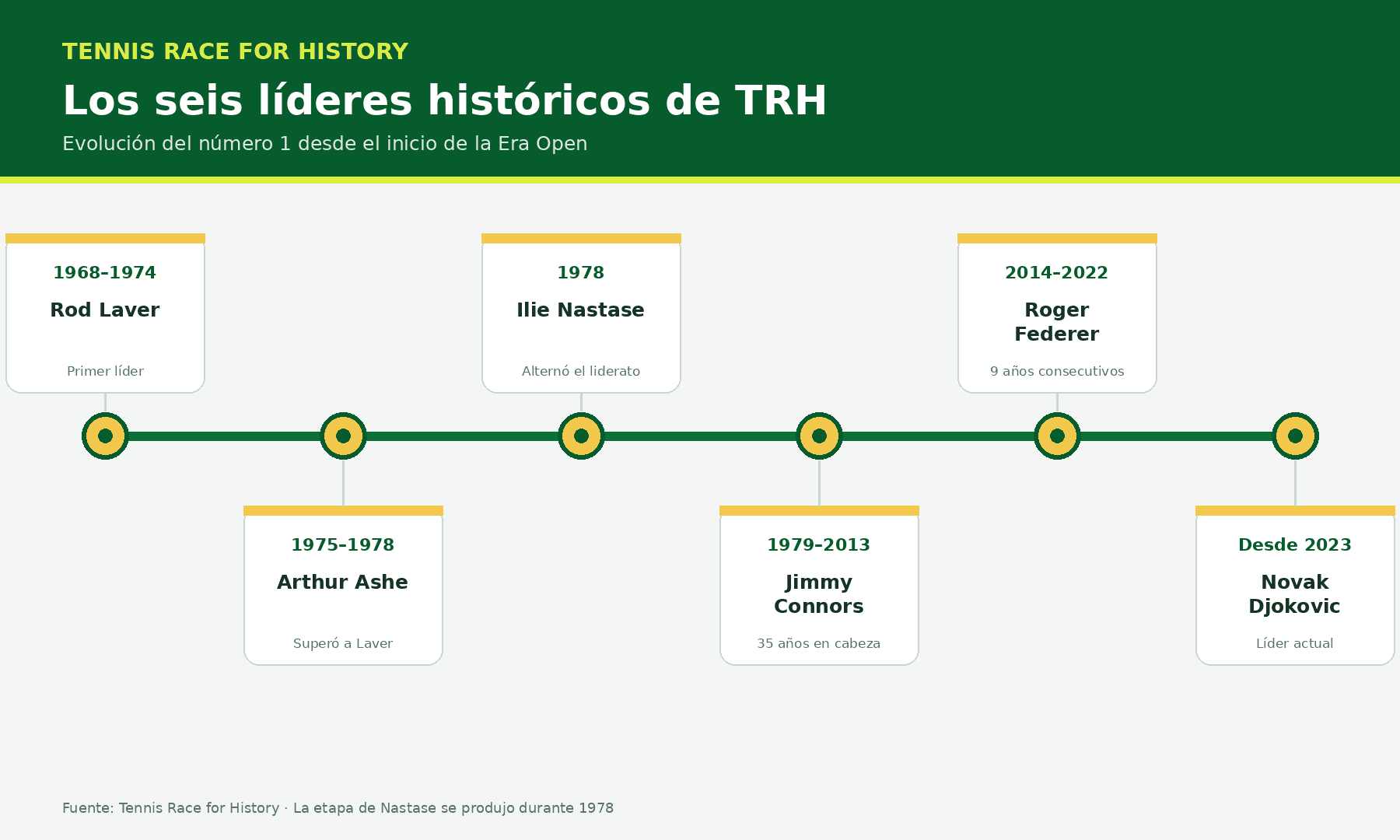
Since the beginning of the Open Era in 1968, only six players have reached No. 1 in the Tennis Race for History (TRH): Rod Laver, Arthur Ashe, Ilie Nastase, Jimmy Connors, Roger Federer and Novak Djokovic.
It is a remarkably short list considering that it covers almost six decades of competition. It also shows how the battle to be considered the greatest tennis player in history has evolved from a perspective different from that of the ATP Ranking.
The TRH All-Time Ranking does not measure only a player’s performance over a single season or the previous 52 weeks. Its system accumulates the points earned by each player throughout his entire career. It therefore rewards titles, victories, consistency and the ability to remain among the elite for many years.
The result is an all-time race that is constantly evolving. Retired players retain the points they accumulated, while active players can continue adding points and climbing the ranking.
Rod Laver, the First Leader of the Open Era
The ranking begins in 1968, the year in which tennis finally opened its major tournaments to both professional and amateur players. At the end of that first season, Rod Laver occupied first place in the Tennis Race for History.
The Australian was already a legend before the beginning of the Open Era, but he was still capable of achieving one of the greatest feats in the history of the sport. In 1969, he won all four Grand Slam tournaments in the same season, an accomplishment no man has repeated since.
Laver led the TRH ranking from 1968 to 1974. His position began to come under threat when he stopped competing regularly and, as a result, was no longer accumulating points at the same rate as the players who dominated the new era of the Tour.
He currently occupies 22nd place, with 53,955 points, 61 titles, 188 ranking tournaments and a record of 573 victories and 146 defeats. His fall down the ranking does not diminish his legacy: he was the first benchmark of the All-Time Ranking during the Open Era.
Arthur Ashe and Ilie Nastase Produce the First Change at the Top
In 1975, Arthur Ashe accumulated enough points to overtake Laver. The American remained at the top in 1975, 1976 and 1977, and also held the lead for part of 1978.
Ashe was an essential figure both on and off the court. He won the first US Open of the Open Era in 1968, captured the Australian Open in 1970 and lifted the Wimbledon trophy in 1975. His consistency allowed him to become the second player to reach No. 1 in the TRH All-Time Ranking.
He currently occupies 15th place, with 68,923 points, 46 titles and a record of 802–260.
The year 1978 introduced an unprecedented situation: Ilie Nastase traded the top position with Ashe. The Romanian, one of the most talented and charismatic players of his generation, therefore became the third leader of the Tennis Race for History.
Nastase currently occupies 14th place, immediately ahead of Ashe, with 70,074 points, 60 titles, 368 tournaments and 895 victories.
Jimmy Connors and a 35-Year Reign
The major turning point came in 1979. Jimmy Connors overtook Ashe and began the longest period of dominance the ranking has ever known.
The American remained at the top for 35 years, from 1979 to 2013. His longevity, enormous volume of matches and extraordinary consistency produced a points total that appeared extremely difficult to surpass.
The figures provided by TRH illustrate the scale of his career. Connors currently occupies fourth place, with 135,916 points, 109 titles, 392 ranking tournaments and a record of 1,270 victories and 283 defeats.
Among the top 22 players, nobody has contested more tournaments or recorded more victories. That competitive volume explains why he was able to retain the lead for more than three decades, long after his retirement.
Roger Federer Ends Connors’ Reign
In 2014, at the height of the Big Three era, Roger Federer finally managed to overtake Jimmy Connors. The Tennis Race for History had waited 35 years for a new leader.
The Swiss player reached the top thanks to an exceptional combination of titles, victories and continuity. His career extended across more than two decades and allowed him to compete at the highest level against several different generations.
Federer led TRH for nine consecutive years, from 2014 to 2022. He currently remains in second place with 173,333 points, 103 titles, 367 tournaments and a record of 1,251–275.
His advantage over Connors is considerable, but it was not enough to retain the lead against the progress of another member of the Big Three.
Novak Djokovic Reaches No. 1 in the All-Time Ranking
In 2023, Novak Djokovic overtook Federer and became the sixth leader of the Tennis Race for History.
The Serbian currently occupies first place with 186,670 points, almost 13,500 more than Federer. He has also accumulated 101 titles, 320 ranking tournaments and a record of 1,178 victories and 242 defeats, according to the current TRH data.
Djokovic has built his lead through an extraordinary combination of major titles, consistency and longevity. His ability to remain among the best players in the world for so many years allowed him to overtake Rafael Nadal first and Federer later.
Under the Tennis Race for History scoring system, these results establish Djokovic as the current GOAT of the TRH All-Time Ranking. This statement refers specifically to the criteria used by the model: he is the player who has accumulated the most points since the beginning of the Open Era.
The Current Tennis Race for History Ranking
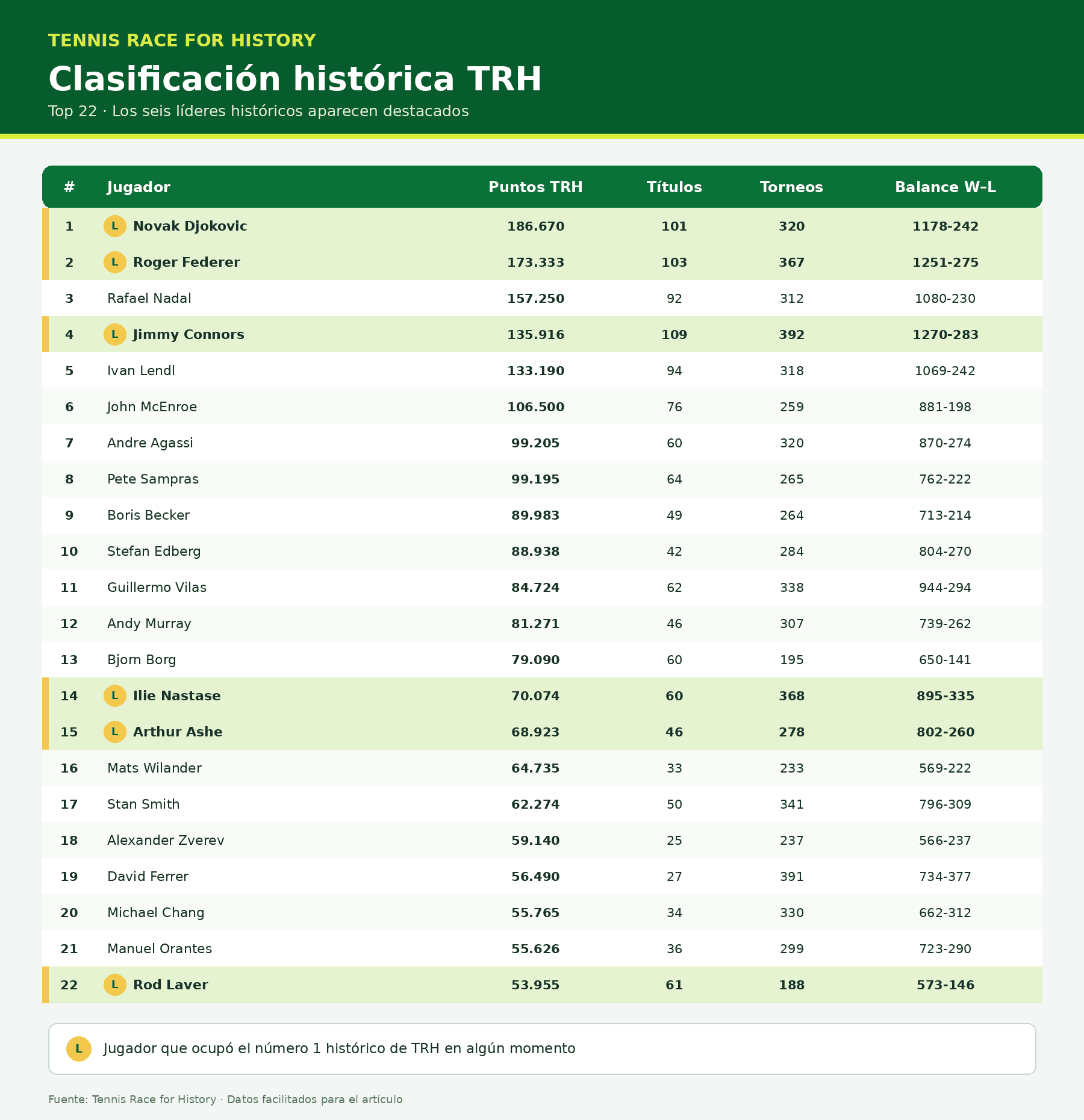
The table shows the top 22 positions in the TRH All-Time Ranking. The six players who have occupied first place at some point are highlighted to make them easier to identify.
The ranking reveals the enormous gap created by the Big Three. Djokovic, Federer and Nadal occupy the first three positions and are the only players to have surpassed 150,000 points.
Jimmy Connors and Ivan Lendl form the next group, both with more than 130,000 points. From John McEnroe in sixth place onwards, no player currently reaches 110,000 points.
The narrow gap between Andre Agassi and Pete Sampras is also striking: only 10 points separate their totals, with 99,205 for Agassi and 99,195 for Sampras.
The active players included in this Top 22 are Djokovic and Alexander Zverev, who occupies 18th place with 59,140 points. The German can still improve his position as he continues adding results.
Who Could Become the Next TRH Leader?
Djokovic’s advantage and the age of the players immediately behind him suggest that the Serbian could remain in first place for many years.
Federer, Nadal and Connors can no longer increase their totals. Djokovic, by contrast, can still add new points while he remains active. This raises the standard that the next generation will have to reach even further.
The leading future candidates include Jannik Sinner and Carlos Alcaraz. Both players have begun their careers at a pace of titles and victories that makes it possible to imagine them eventually reaching the highest positions in the all-time ranking. However, approaching Djokovic’s record will require much more than several brilliant seasons.
To challenge for the lead, they will have to maintain an extraordinary level for more than a decade, avoid major injuries and retain the motivation required to compete throughout a very long career. The speed of their progress makes their development worth following, but it is still too early to establish a specific date or guarantee that either of them will reach the top.
Six Leaders in Almost Six Decades
The evolution of the all-time No. 1 position summarises a fundamental part of the Open Era. Laver opened the ranking. Ashe and Nastase produced the first battle for the lead. Connors built a 35-year reign. Federer brought that reign to an end, and Djokovic eventually raised the record to 186,670 points.
Across almost six decades, thousands of players have competed on the Tour, but only six have occupied first place in the Tennis Race for History.
The next change could take many years. Until that moment arrives, Djokovic retains a considerable advantage and remains the benchmark that the new generations must pursue.
Create your own tennis rankings
Want to discover which players have achieved the best results at the US Open? Use the Tennis Race for History filters to compare players by tournament, surface, era, country, age and many other criteria.
Explore tennis history using our filters