
 Castellano
Historical ranking of Miami Masters tennis with Alcaraz, Sinner and Zverev
The Miami Masters plays a key role in the rise of active players. We analyze how Alcaraz, Sinner, and Zverev move up the historical tennis ranking and shape the future GOAT debate.

The debate around the tennis GOAT (Greatest Of All Time) continues to evolve with every major tournament. However, not all events impact the historical ranking in the same way. The Miami Masters 1000, while one of the most prestigious tournaments on the calendar, plays a very specific role in shaping the historical ranking of tennis.
Rather than drastically altering the all-time hierarchy, Miami tends to influence active players climbing the rankings, making it a key tournament for understanding the evolution of the current generation.
So, after Miami, the real question is not only who leads the GOAT debate — but who is getting closer.
Miami Masters: Limited impact on all-time legends
Unlike Grand Slams, the Miami Masters does not significantly change the positions of historical legends such as:
- Novak Djokovic
- Roger Federer
- Rafael Nadal
At the top of the historical ranking, these players have built such a large points gap that a single Masters 1000 tournament has minimal effect on their overall standing.
For example:
- Djokovic remains firmly at the top with over 182,000 points
- Federer and Nadal continue to hold strong positions in the all-time Top 3
This reinforces an important idea:
The GOAT debate is built over years — not decided in one tournament.
You can explore this in detail in the
historical tennis ranking
Where Miami really matters: active players
While Miami has limited impact at the very top, it becomes much more relevant when analyzing players currently competing on tour.
This is where the real movement happens.
Following the latest Miami edition, the main beneficiaries are:
- Alexander Zverev
- Carlos Alcaraz
- Jannik Sinner
These players are actively accumulating points and improving their positions within the historical ranking.
Key battle zone: positions 30–41
One of the most interesting areas of the ranking right now is the range between positions 30 and 41, where the new generation is starting to break through.
Current snapshot:
- Carlos Alcaraz – Position 40 (~39,770 points)
- Jannik Sinner – Position 41 (~39,555 points)
- Daniil Medvedev – Slightly ahead
- Several historical players just above them
This zone is critical because:
- Points differences are smaller
- Positions can change faster
- Momentum matters more
This is where Miami has real impact.
A strong result in Miami allows these players to close the gap with established names and move closer to the elite.
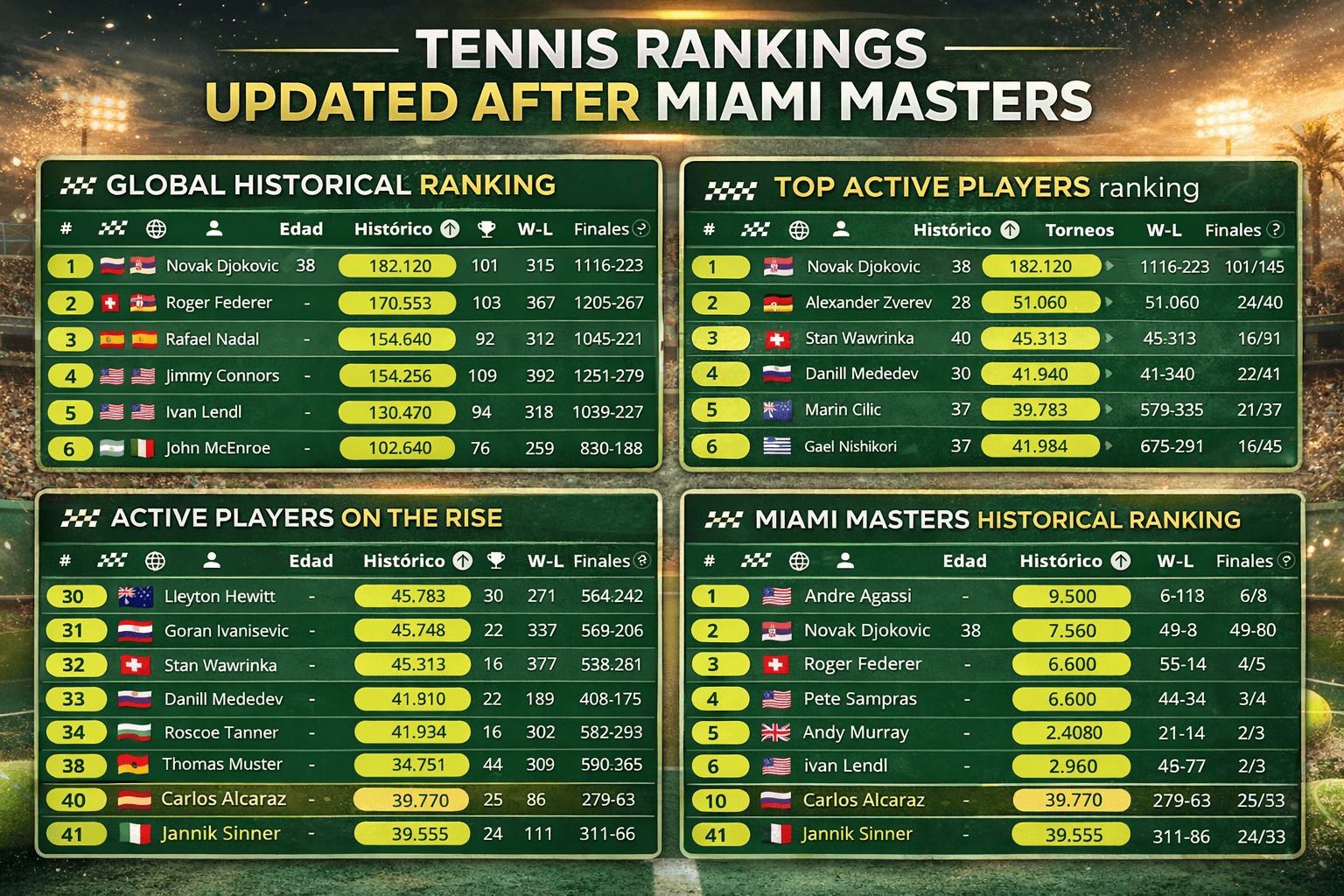
Active ranking: Zverev leading the chase
Looking specifically at active players, a different hierarchy emerges.
Top active players include:
- Novak Djokovic (still dominant)
- Alexander Zverev (~51,060 points)
- Stan Wawrinka
- Daniil Medvedev
- Carlos Alcaraz
- Jannik Sinner
Zverev currently holds a strong position as the second-best active player historically, highlighting his consistency over the years.
However, players like Alcaraz and Sinner are progressing much faster in terms of career trajectory.
Miami Masters historical leaders
Looking at the specific history of the Miami Masters, we find a different set of leaders:
- Andre Agassi – Leader in historical points
- Novak Djokovic – 6 titles
- Roger Federer – 4 titles
- Pete Sampras – 3 titles
- Andy Murray – 2 titles
Among active players:
- Jannik Sinner has already secured a title
- Daniil Medvedev has also won the tournament
This shows that while Miami has strong historical significance, its real-time impact is more visible in rising players.
Alcaraz vs Sinner: the future battle
The rivalry between Carlos Alcaraz and Jannik Sinner is becoming one of the defining narratives of modern tennis.
From a historical perspective:
- Both are currently outside the Top 30
- Both are climbing rapidly
- Both are accumulating key titles
Miami plays an important role in this rivalry because:
- It offers high-value points
- It provides direct comparison opportunities
- It accelerates ranking progression
Every result counts in this stage of their careers.
Why Miami still matters in the GOAT debate
Even if Miami does not drastically reshape the top of the historical ranking, it remains important because:
- It helps build long-term consistency
- It rewards performance against top players
- It contributes to career accumulation
- It accelerates generational transitions
In short:
Miami does not define the GOAT — but it helps build one.
Conclusion: a tournament of progression, not revolution
After the Miami Masters, the GOAT debate remains largely unchanged at the top.
- Djokovic continues as the most complete historical player
- Federer and Nadal maintain their legacy positions
- No major shifts occur among the all-time elite
However, the real story lies elsewhere:
The rise of the new generation.
Players like Alcaraz, Sinner, and Zverev are using tournaments like Miami to:
- Gain positions
- Build consistency
- Strengthen their historical profile
The tennis GOAT debate is not static — it evolves.
And while Miami may not rewrite history in a single week, it moves the pieces on the board.
The future of tennis is being built step by step — and Miami is one of those steps.