Castellano
Who is the GOAT of tennis after Miami?
The Miami Masters plays a key role in the rise of active players. We analyze how Alcaraz, Sinner, and Zverev move up the historical tennis ranking and shape the future GOAT debate.

The debate around the tennis GOAT (Greatest Of All Time) is more alive than ever. Every major tournament adds new pieces to the historical puzzle, and the Miami Masters 1000 is no exception.
Considered one of the most important events outside the Grand Slams, its impact on the historical ranking of tennis is key to understanding how the race for the top of the sport evolves.
After Miami, the question becomes inevitable once again:
who is truly the greatest tennis player of all time?
The GOAT debate: more than Grand Slams
For years, the discussion around the greatest tennis player of all time focused mainly on Grand Slam titles. However, modern analysis is much broader.
Today, determining the tennis GOAT involves several criteria, including:
- Grand Slam titles
- Major titles: Grand Slams + Masters 1000 + ATP Finals
- Weeks as World No. 1
- Total number of titles won
- Win–loss record (W-L) and win percentage
In this context, the historical tennis ranking provides a more complete view, measuring a player’s overall career performance.
You can explore it in detail in the
historical tennis ranking
The impact of Miami on tennis history
The Miami Masters is one of the most demanding tournaments on the tour. Its timing, surface, and level of competition make it a key event within the Masters 1000 series.
Winning in Miami does not only mean earning 1,000 ATP points, but also strengthening a player’s position in the historical context.
Over the years, this tournament has been decisive in:
- Consolidating leadership
- Creating separation between rivals
- Defining dominant seasons
- Reinforcing GOAT candidacies
Ultimately, Miami acts as a turning point in the historical narrative of modern tennis.
Big 3: the core of the GOAT debate
Any discussion about the tennis GOAT inevitably revolves around the three players who have dominated the sport for more than a decade:
Novak Djokovic
The Serbian has built one of the most complete careers in tennis history. His dominance across all surfaces, consistency, and longevity place him as the leading candidate in the GOAT debate.
His performances in tournaments like Miami have been key to consolidating his position in the historical ranking.
Roger Federer
The Swiss legend defined an era. His style, consistency, and global impact made him one of the most influential players of all time.
Although his peak came earlier, his results in Masters 1000 tournaments like Miami remain fundamental in any historical analysis.
Rafael Nadal
The Spaniard dominated clay courts, but his legacy goes far beyond that. His competitiveness, longevity, and adaptability keep him firmly in the GOAT conversation.
His success on the biggest stages reinforces his position in the historical tennis ranking.
Beyond the Big 3: the new generation
Recent developments on the tour make one thing clear: the GOAT debate will not end with the Big 3.
Players such as:
- Carlos Alcaraz
- Jannik Sinner
are already building their own historical narratives.
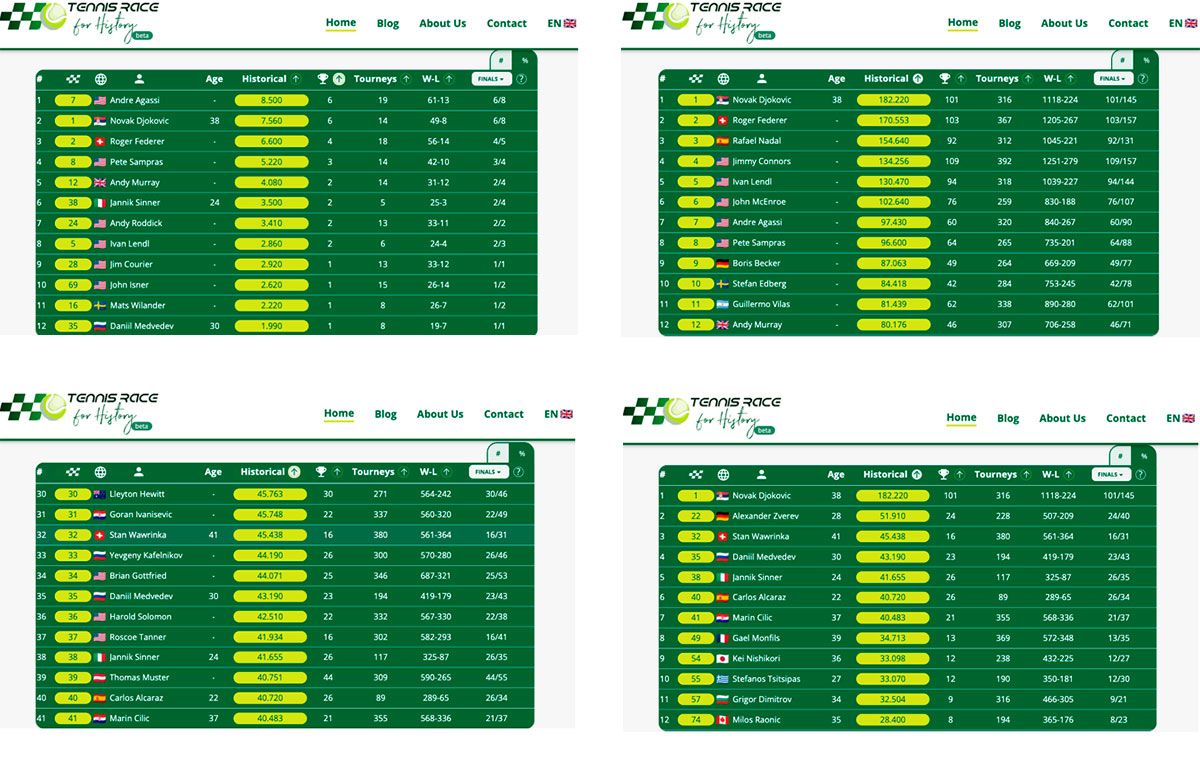
After Miami, both continue climbing the historical ranking, gradually closing the gap with tennis legends.
Notably, Jannik Sinner has jumped to World No. 38, overtaking Carlos Alcaraz (No. 40) after completing the Double Sunshine.
Can they challenge the Big 3 legacy?
This progression raises an important question:
Can the new generation truly challenge the Big 3 legacy?
The historical tennis ranking reflects long-term achievements, and after Miami, several trends are clear:
- Djokovic remains the absolute reference
- Federer and Nadal still hold elite positions
- The new generation is closing the gap
- Active players continue accumulating key points
What matters is not only the current position, but also the future projection.
Tournaments like Miami are crucial because they:
- Reward consistency
- Value performance against top rivals
- Increase the historical weight of each season
The importance of Masters 1000 in the GOAT debate
One of the most common mistakes in analyzing the greatest tennis player of all time is underestimating Masters 1000 tournaments.
These events:
- Bring together the best players in the world
- Feature highly competitive draws
- Demand elite performance throughout the week
That’s why titles in tournaments like Indian Wells or the Miami Masters have strategic value in the historical ranking.
You can explore this impact in detail here:
Masters 1000 titles
Who really leads the GOAT race after Miami?
The answer depends on the criteria used, but when analyzing all historical variables, one conclusion stands out:
Novak Djokovic remains the most complete player overall
His combination of:
- Titles
- Consistency
- Longevity
- Multi-surface dominance
places him at the top of the GOAT debate.
However, the gap is not fixed.
The key factor: time
The tennis GOAT is not decided in a single tournament — or even in a single season.
It is built through:
- Years of consistency
- Adaptability
- Performance in key moments
While Djokovic leads today, the future remains open.
Players like:
- Carlos Alcaraz
- Jannik Sinner
have enough time to:
- Win major titles
- Improve their statistics
- Climb the historical ranking
Among active players, due to their age, they are the only ones realistically capable of approaching the greatest legends.
Additionally, Alexander Zverev could aim for a Top 15 historical position if he maintains his current trajectory.
Conclusion: an open debate
The Miami Masters once again shows that tennis is a constantly evolving sport.
The GOAT debate is not closed, but it does have a clear foundation:
- The Big 3 still define the historical standard
- Novak Djokovic currently leads the race
- The new generation is knocking on the door
In the Tennis Race for History, every tournament matters.
And Miami, once again, has moved the pieces on the board.
The final outcome is still being written.